

The best early-season hikes
Livigno 20/05/2026
The changing season: conditions, altitude, terrain, and local traditions
At 1,816 meters above sea level, the beginning of summer means one thing above all: the terrain becomes accessible again. Temperatures rise, the snow retreats from the south- and southwest-facing slopes, and the first single tracks clear up and become passable without winter equipment. The ground is still damp and compact — perfect for those who want to get back into rhythm without immediately tackling major elevation gains. The days grow longer, the light becomes more stable, and temperature fluctuations decrease: ideal conditions to return to hiking consistently.
Early-season hiking: what it really means
For a hiker, May is a strategic month. The focus is not yet on high ridgelines or altitudes of 2,500–2,800 meters, but rather on building endurance, pace, and adaptability to the terrain. Hiking becomes a preparation phase: regaining confidence with altitude, testing boots and backpacks, and working on breathing and stamina after winter. It’s an approach that doesn’t aim for peak performance, but for the athletic foundation on which to build the season.
The first trails to reopen: routes, exposure, and elevation gain
Sentiero delle Tee – South-facing exposure, even terrain, and moderate elevation gain. Perfect for getting back into rhythm and working on pace consistency.
Val Federia (initial section) – Wide and gradual, ideal for progressively increasing distance and time on the move.
Lake route – Livigno Trail – A smooth-flowing route, great for those who want to alternate fast walking with more technical sections.
Walking as a form of well-being
May hiking is not about performance: it’s about finding your rhythm again. The altitude, the light, the silence of the woods, and the ground slowly drying out create the ideal environment for a kind of movement that asks not for speed, but for presence. Walking becomes a simple, restorative act — a way to reactivate the body after winter and reconnect with the high valley, following the trails as they reopen and letting the mountains set the pace.
Technique and sensations: trekking as a complete workout
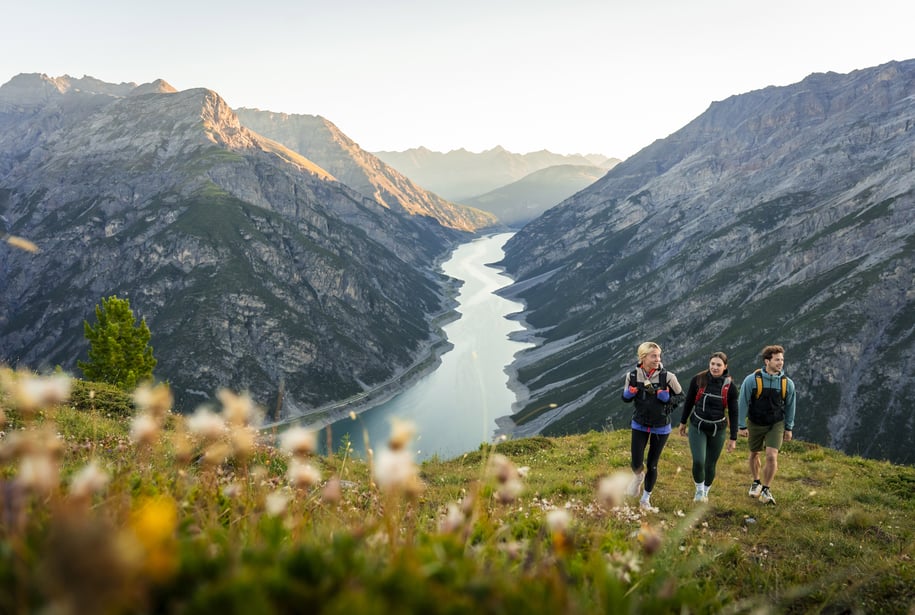
Early-season trekking is, in every sense, a technical workout. The still-damp ground requires precise footing, careful balance, and good pace management on shaded sections, where lingering snow can make the terrain more slippery. The altitude of 1,816 meters helps reactivate breathing and endurance without placing excessive stress on the muscles, while the gradual climbs toward Val Federia allow hikers to work on aerobic resistance.
It’s a complete form of training: it improves balance, strength, terrain-reading skills, and effort management. Walking becomes an athletic movement that prepares the body for the more demanding outings of June and July, when routes begin to climb above 2,300–2,500 meters and a solid base is essential to tackle greater elevation gains.
Practical tips for those who want to start strong
At this stage of the season, experienced hikers know that preparation makes all the difference. Damp terrain requires shoes with solid grip and soles capable of handling mixed surfaces such as dirt, roots, and lingering patches of snow. Trekking poles become especially useful for stabilizing your stride on the first climbs and for distributing effort more efficiently, particularly when getting back into shape after winter.
Clothing should be adaptable: cool mornings, warmer afternoons, and temperature variations that change quickly depending on sun exposure. It’s important to choose routes with good drainage and trails that allow you to gradually increase both distance and elevation gain, avoiding higher altitudes where snow may still be present.
Careful planning, combined with the ability to read both weather conditions and terrain, helps build a strong foundation for the entire hiking season.


0 Comments